
Of the seven surveys presented under Modi govt, predictions of three were quite close to the actual GDP growth rate, one saw the base year change in between, but the last three were way off the mark.

Have the markets already played out their dynamics before the economy has even properly taken off? Are we now destined for a period of mediocre returns despite a strong economy? asks Akash Prakash.

India's economic growth had slumped to decade low of 5 per cent in 2012-13.

Those hardest hit by the second wave of the pandemic have been blue-collared workers, doctors and healthcare workers, law and order and municipal personnel, individuals eking out daily livelihood, and small businesses. And there should be more measures taken to alleviate their pain, the Reserve Bank of India (RBI) said on Monday. The report also indicated that the RBI's growth numbers might have to be revisited as the central bank's real GDP growth projection of 26.2 per cent given in the MPC's resolution of April 7 for the first quarter of 2021-22, were "made before the full fury of the resurgence." Nevertheless, the "resurgence of COVID-19 has dented but not debilitated economic activity in the first half of Q1: 2021-22.

The economy faces more downside risks now as economic disruptions arising from the second wave are likely to stabilise only from July, warned the Swiss brokerage USB Securities. Last month, the brokerage had cut its GDP forecast by 150 bps to 10 per cent for FY22, which though is much higher than the consensus projections by others with some pegging it at as low as 8 per cent. Though adverse impacts on sequential growth is less severe than in the June 2020 quarter when it plunged by 23.9 per cent, as lockdowns are more targeted and localised and households and businesses have adjusted to the new normal now, still, it is increasingly possible that normalcy returns only by July as against our baseline assumption of June.

The finance minister said figures for second quarter economic growth are yet to come, but industry has started picking up. The Indian economy grew by 6.1 per cent in the first quarter. On inflation, Mukherjee said the government has taken steps to ensure that the adverse impact of inflationary pressures is reduced by strengthening supply management.

"We forecast 7.3 per cent GDP growth (current financial year). We expect fundamentals to improve next year, propelling a recovery in H2 FY10," Lehman Brothers said in a report. For the first quarter ended June 2008, the economy registered a growth of 7.9 per cent against 9.2 per cent in the same period last year.

Most rate-sensitive stocks ended on a negative note, with BSE auto, bankex, finance and realty indices cracking up to 2.10 per cent.

After falling 10 per cent against the greenback in 2022, the rupee staged a comeback in 2023 as it appreciated, albeit marginally, on the back of strong portfolio inflows, in addition to timely intervention by the Reserve Bank of India. The Indian unit appreciated by 0.16 percent in six months until June 28. The rupee stood in third place in terms of appreciation against the US dollar among the 12 Asian currencies and in 12th place of the 23 emerging-market currencies.

'If you look at the order books of capital equipment companies or money deployed on the ground, there is forward movement in terms of actual investment by the private sector.'

The previous high GDP growth of 8.1 per cent was recorded in April-June quarter of 2016-17.
Forecasting 7.2 per cent GDP growth for the current fiscal, industry chamber CII on Tuesday stressed on sustainable development for alleviating poverty and employment generation in the country.

Attributing the growth to an upswing in consumption and investment, the World Bank has said India will continue to be the fastest growing major economy in the world.

Top losers in the Sensex pack included IndusInd Bank, Yes Bank, SBI, L&T, Tata Steel, M&M, Bajaj Finance, Vedanta, Tata Motors and RIL, tumbling up to 6.97 per cent.
Credit rating agency ICRA disputed the official forecast of a lower 4.4 per cent growth in GDP, and said all indications in reality are that the economy was slated to grow by 5.4-5.5 per cent this fiscal.
"We expect GDP growth to slow from 7.3 per cent year-on-year in July-September 2016 to 6.0 per cent in October-December 2016 and 5.7 per cent in January-March 2017," Nomura said in a research note.

According to China's National Bureau of Statistics, the GDP expanded 9.5 per cent year-on-year, which is a decline compared to the 9.7 per cent rate achieved in the first quarter.

Rating agencies Crisil and Icra on Monday revised down their India growth projections for the current fiscal and the second quarter mainly due to the ripple effect of slowdown in global growth and mixed crop output. Crisil downgraded the India growth forecast by 30 bps to 7 per cent while Icra pegged the economic expansion at 6.5 per cent for the second quarter of FY2022-23. "We have revised down our forecast for real gross domestic product growth to 7 per cent for fiscal 2023 from 7.3 per cent, primarily because of the slowdown in global growth that has started to impact our exports and industrial activity.

Among the Sensex firms, ITC, Kotak Mahindra Bank, ICICI Bank, Nestle, Axis Bank, IndusInd Bank, UltraTech Cement, Bajaj Finance, Maruti and HDFC Bank were the major laggards.

"The Monetary Policy Committee recognises that there is monetary policy space for future action. However, given the evolving growth-inflation dynamics, the MPC felt it appropriate to take a pause at this juncture," the RBI said in its fifth bi-monthly monetary policy for this fiscal.
The Monetary Policy Committee (MPC) is expected to maintain the status quo on policy rates for the fourth consecutive time in its October 4-6 review meeting. The incremental information available since its last meeting in August suggests that growth and inflation prints for the second quarter (Q2) of financial year 2023-24 (FY24) will exceed the committee's projections. However, the Consumer Price Index (CPI)-based inflation is expected to moderate in the second half (H2) of FY24.
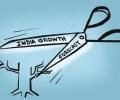
The International Monetary Fund (IMF) on Tuesday lowered India's economic growth projection for the current fiscal to 5.9 per cent from 6.1 per cent earlier. Yet India will continue to be the fastest-growing economy in the world. In its annual World Economic Outlook, IMF also lowered the forecast for 2024-25 fiscal (April 2024 to March 2025) to 6.3 per cent from the 6.8 per cent it had predicted in January this year. The growth rate of 5.9 per cent in the 2023-24 fiscal compares to an estimated 6.8 per cent in the previous year.
.jpg)
The RBI said lead indicators point to continuing sluggishness in domestic economic activity in the first quarter of 2014-15.

Growth in the third quarter (October-December) is expected to be the weakest in years, with spending hit due to unavailability of enough replacement currency.

The Asian Development Bank too had projected Indian's economic growth for current fiscal at 7.4 per cent.
Foreign investment firm Credit Suisse First Boston said on Thursday that delayed monsoon is unlikely to have a "significant impact" on India's economic growth pegged at 5.7 per cent in 2004-05.

Benchmark indices--Sensex and Nifty--were 0.7-0.8 per cent higher from the Saturday closing. Among the widely-tracked Nifty 50 stocks, 39 advanced and the rest 11 declined at the opening bell. Among the individual stocks, Cipla, ICICI Bank, Sun Pharma, Power Grid Corp, and Bharti Airtel were the top five gainers, while Asian Paints, Hindustan Unilever, Britania, HDFC Bank, and BPCL the losers, NSE data showed. On Monday, Indian stock exchanges were closed for trading on the occasion of Pran Pratistha of Ram Temple in Ayodhya.
Higher for longer' may be the narrative in the developed markets, but interest rates might not stay high for very long in India, with a section of the market expecting rate cuts to begin this year. The six-member Monetary Policy Committee of Reserve Bank of India (RBI) decided to keep interest rates unchanged at 6.5 per cent in the April review - after hiking the policy repo rate in six previous meetings. RBI Governor Shaktikanta Das emphasised that the pause was only for the April policy and that the central bank was ready to act if the situation demanded.

While the economy seems to be on a firm growth path, the fight against inflation is not over yet. Shaktikanta Das seems to be in no hurry. After playing well through a five-year Test match, he doesn't want to get out hit wicket, observes Tamal Bandyopadhyay.

'The private sector believes that some enablers in labour-intensive sectors like apparel, toys, tourism, and media retail, can unlock a lot of jobs.'
The economy is slated to grow by 6.3 per cent over the financial year 2004-05 and accelerate to 6.8 per cent in the next fiscal, credit rating agency ICRA said on Tuesday.

"According to the global financial services major, though CAD at 3.2 per cent of GDP is significantly lower than the 4.8 per cent it registered in fiscal year 2012-13 ", it still remains higher than the 2.4 per cent of GDP that we estimate as the optimal current account deficit".

Macroeconomic data announcements, global trends and trading activity of foreign investors would guide momentum in the equity market this week, analysts said. Markets ended a five-week losing streak and gained nearly a per cent last week, helped by a sharp rebound on Friday. Last week, the BSE benchmark jumped 500.65 points or 0.77 per cent and the Nifty gained 169.5 points or 0.87 per cent.

The GST revenues for August 2023 have shown a growth of 11 per cent year on year due to increased compliance and less evasion, Revenue secretary Sanjay Malhotra said on Friday. The collection from Goods and Services Tax (GST) was Rs 1,43,612 crore in August 2022. "Roughly numbers are in the range of 11 per cent year on year growth as in earlier months," Malhotra told reporters.

India's central bank has however, forecast an 8.2 per cent economic growth in FY 11.

Weighed down by a weak rupee, the Reserve Bank on Tuesday chose to keep all key interest rates unchanged and asked the government to take urgent steps to reign in the high current account deficit.

India's budget for the fiscal beginning April focuses on giving a boost to the ongoing economic recovery through a sharp increase in capex spending but is short on major growth-enhancing structural reform announcements, Fitch Ratings said Wednesday. The deficit targets present in the Union budget 2022-23 by Finance Minister Nirmala Sitharaman on Tuesday "are a bit higher than our forecasts when we affirmed India's 'BBB'/Negative sovereign rating in November," said Jeremy Zook, director and primary sovereign analyst for India, Fitch Ratings. While it was widely expected that the fiscal deficit will be lower than the targeted 6.8 per cent of the GDP in the current fiscal year ending March 31, 2022, Sitharaman put the number at 6.9 per cent.
The World Bank on Thursday forecast a 6.7 per cent growth rate for India by next fiscal as exports and private investment are projected to strengthen and provide a boost to growth.

Fitch on Tuesday affirmed India's sovereign rating at 'BBB-' with a stable outlook, on robust growth and resilient external finances, but said weak public finances remain a challenge. India's rating has been unchanged at 'BBB-', which is the lowest investment grade, since August 2006. "Fitch Ratings has affirmed India's Long-Term Foreign-Currency Issuer Default Rating (IDR) at 'BBB-' with a Stable Outlook," it said in a statement, adding strong growth potential is a key supporting factor for the sovereign rating.

The size of the GDP in the second quarter of 2018-19 is estimated at Rs 33.98 lakh crore, as against Rs 31.72 lakh crore a year ago
